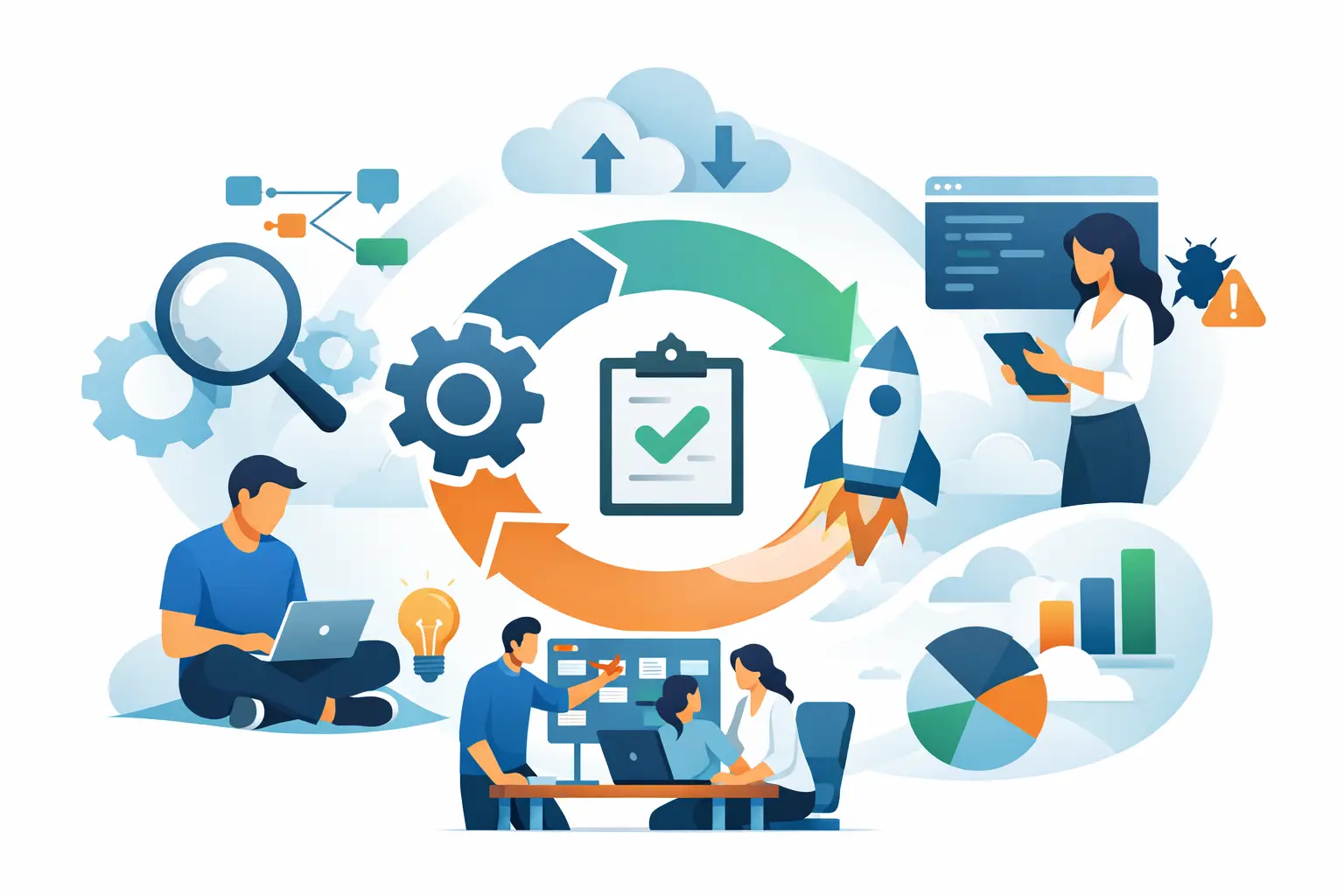
A program can have a well-defined scope, a capable systems integrator, and a committed business team, yet still lose momentum when decisions, requirements, testing evidence, and risks live in different places. SAP Cloud ALM project governance gives SAP transformation leaders a practical way to establish control without creating another reporting layer that teams must maintain manually.
For organizations moving to SAP S/4HANA Cloud, implementing SAP cloud solutions, or managing complex release programs, governance must do more than document status. It must make ownership visible, connect work to business outcomes, expose delivery risk early, and provide leaders with evidence for critical decisions.
What SAP Cloud ALM Project Governance Should Accomplish
Project governance is often treated as a calendar of steering committee meetings. That is only one component. Effective governance defines how work is planned, who approves key decisions, how risks are escalated, and what evidence demonstrates readiness to proceed.
SAP Cloud ALM for Implementation provides the working structure for much of this discipline. It brings requirements, process design, tasks, testing, defects, deployment preparation, and project reporting into a connected delivery environment. Rather than asking project managers to reconcile multiple spreadsheets before every governance meeting, teams can use current delivery information to focus conversations on exceptions, decisions, and actions.
The goal is not to make every activity visible to every stakeholder. It is to provide each audience with the right level of insight. A workstream lead needs task ownership and impediments. A test manager needs execution progress and defect trends. A program sponsor needs confidence that the program is meeting milestones, controlling risk, and protecting business readiness.
Build Governance Around Decisions, Not Status Updates
The strongest governance model starts by identifying the decisions that can materially affect cost, timeline, compliance, operational stability, or adoption. Typical examples include approving scope changes, accepting process design, authorizing test completion, accepting cutover readiness, and proceeding to production.
For each decision, establish the accountable owner, required evidence, review cadence, and escalation path. This prevents a common failure mode: a decision appears in meeting notes but has no clear approver, no deadline, and no traceable rationale.
SAP Cloud ALM can support this discipline when teams connect their work items and deliverables to the decision process. For example, design approval should be supported by documented requirements and process decisions. A testing exit decision should reference execution results, defect severity, retest status, and any accepted residual risk. Go-live approval should be based on a defined readiness view, not a general sense that the team is ready.
This approach also improves accountability across business and IT. The project team can clearly distinguish between a technical issue requiring remediation, a business decision requiring approval, and a risk that needs executive attention.
Define a minimum governance dataset
Every program does not need the same amount of governance. A focused deployment may need a lighter model than a global transformation with multiple countries, integrations, and regulatory requirements. The principle is to define a minimum dataset that supports reliable decisions without turning SAP Cloud ALM into a repository of incomplete administration.
That dataset commonly includes approved scope and requirements, milestone plans, workstream actions, risks and issues, testing and defect status, decision records, deployment readiness criteria, and ownership for every open item. If an item cannot be tied to an owner and a target date, it is not yet governable.
Establish Roles Before Configuring the Tool
Cloud ALM configuration will not resolve unclear operating roles. Before defining projects, teams, or reporting views, agree on who owns delivery decisions and who maintains each type of information.
The program manager should own governance cadence, milestone integrity, escalation, and cross-workstream coordination. Workstream leads should maintain the delivery activities and dependencies within their areas. Business process owners should validate requirements, process outcomes, and acceptance decisions. Test and release leads should own the quality evidence that supports deployment readiness. Platform, Basis, and operations teams should be involved early enough to validate monitoring, support procedures, access, integrations, and operational handover.
The distinction between accountability and contribution matters. A finance process owner may contribute to testing, but should not be expected to manage defect triage. An implementation partner may configure a process, but the business must retain ownership of business acceptance. When these boundaries remain vague, issues surface late and governance forums become debates about responsibility rather than decisions about delivery.
Make Requirements and Testing Traceable
Traceability is one of the most valuable governance outcomes available through SAP Cloud ALM. Leaders need to know whether approved business requirements have been designed, configured, tested, and accepted. Teams need the same traceability to avoid losing critical scope during compressed delivery cycles.
Start with a requirement structure that business stakeholders can understand. Avoid creating hundreds of overly technical records that obscure the actual outcomes the program must deliver. Requirements should be organized around business capabilities, processes, releases, or workstreams in a way that supports reporting and ownership.
Then connect requirements to the relevant tasks, test cases, and defects. This creates a more credible view of progress. A workstream marked as 90 percent complete may still carry significant risk if its highest-priority requirements have not passed testing. Conversely, a high count of low-impact open tasks may not threaten a release if critical business flows are proven.
Traceability does require discipline. It depends on teams updating statuses, using agreed naming conventions, and avoiding duplicate records. The trade-off is clear: more detailed linkage produces better evidence, but only if the project has the capacity and governance maturity to maintain it. For many programs, a focused traceability model centered on high-risk and high-value requirements is the right starting point.
Use Governance Cadences That Drive Action
A weekly project status meeting should not become a reading of dashboards. The dashboard should be reviewed in advance. The meeting should address the items that need a decision, an escalation, or a committed recovery action.
At the delivery level, workstream forums can review overdue activities, dependencies, risks, and testing blockers. At the program level, the focus should shift to milestone confidence, cross-functional impacts, unresolved decisions, and budget or scope implications. Steering committees should address matters that cannot be resolved within the program team, such as major scope trade-offs, resource constraints, policy decisions, or acceptance of material residual risk.
Each forum needs a defined input and output. Inputs may include Cloud ALM project status, risk trends, defect aging, and readiness results. Outputs should be decisions, action owners, due dates, and escalation records. This is where governance becomes operational rather than ceremonial.
Connect Implementation Governance to Operations
A successful go-live is not the end of governance. It is the point where implementation controls must transition into operational discipline. Too often, monitoring, support ownership, service processes, and operational reporting are treated as post-go-live concerns. That creates avoidable risk during hypercare, when the organization has the least tolerance for uncertainty.
Bring operations teams into governance before deployment. Confirm which business processes, integrations, jobs, and interfaces require monitoring. Define alert ownership, incident routing, service-level expectations, and the evidence needed to close hypercare. SAP Cloud ALM for Operations can extend the governance model beyond project delivery by giving operational teams visibility into health, events, and service management activities.
For larger landscapes, Cloud ALM data may also need to be incorporated into broader operational dashboards and management reporting. The right design depends on the audience and the existing monitoring strategy. The objective is consistent: project teams should hand over more than a configured system. They should hand over a supportable service with clear ownership and measurable operating controls.
Common Governance Gaps to Address Early
Several patterns repeatedly weaken SAP program governance. The first is treating Cloud ALM as a project tool owned only by the PMO. Business, testing, release, and operations teams must each see a reason to maintain accurate information. The second is building elaborate dashboards before agreeing on the underlying definitions. A red status has little value if teams do not share a definition of what red means.
Another gap is reporting activity instead of outcomes. Large task volumes can create an appearance of control while critical decisions remain unresolved. Finally, many programs wait until the final weeks to define cutover and operational readiness. By then, missing access, unsupported interfaces, incomplete monitoring, or unclear support ownership can become go-live risks.
These gaps are addressable through an early governance design workshop, a practical Cloud ALM configuration approach, and role-based enablement. CloudALMexperts helps organizations translate governance requirements into usable SAP Cloud ALM practices that support implementation and the transition to operations.
A well-governed SAP program does not produce more meetings or more reports. It produces clearer decisions, earlier risk signals, and a delivery record leaders can trust. Start by defining the next decision your program must make, the evidence it requires, and the owner accountable for it. That is the foundation for governance that holds up when delivery pressure increases.