How Successful Organisations Replace Solution Manager
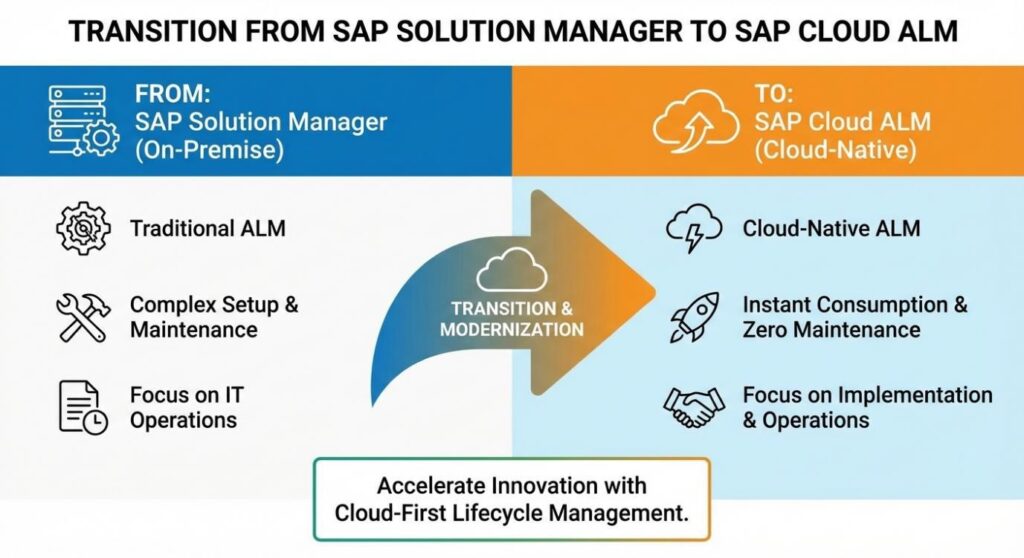
Successful organisations do not migrate from SAP Solution Manager to SAP Cloud ALM.
They replace capabilities — deliberately and in phases.
Across multiple transitions, a consistent pattern emerges.
The organisations that avoid disruption follow five structured stages:
Observe:
Understand what Solution Manager is truly controlling today — including undocumented dependencies.
Stabilize:
Remove inconsistencies, clarify ownership, reduce unnecessary complexity.
Introduce:
Activate Cloud ALM in controlled domains while Solution Manager still runs in parallel.
Replace:
Move capabilities one by one — monitoring, change, testing, documentation — not all at once.
Retire:
Decommission Solution Manager only when replacement is verified.
This approach reduces risk, protects governance, and maintains operational continuity.
It also shifts the conversation from migration to lifecycle control.
The transition is not a deadline-driven event.
It is a structured transformation of how SAP is governed and operated.
For organisations currently planning their exit strategy, the most important decision is not when to move — but how structured the replacement approach will be.
Because once the replacement starts, clarity becomes the most valuable asset.
Core Capabilities
Reliability of Business Services:
Monitoring services end-to-end ensures continuity of critical operations
Proactive Issue Resolution:
Events affecting business services are detected and addressed before they escalate.
Efficiency and Focus:
Automation reduces repetitive tasks, allowing teams to focus on high-value operational and strategic activities.
Business Alignment
IT operations are evaluated based on their impact on business outcomes rather than isolated technical metrics.
Enhanced Visibility:
Executives and stakeholders gain clarity on service performance and operational health.