The Organisational Shift Most Teams Underestimate
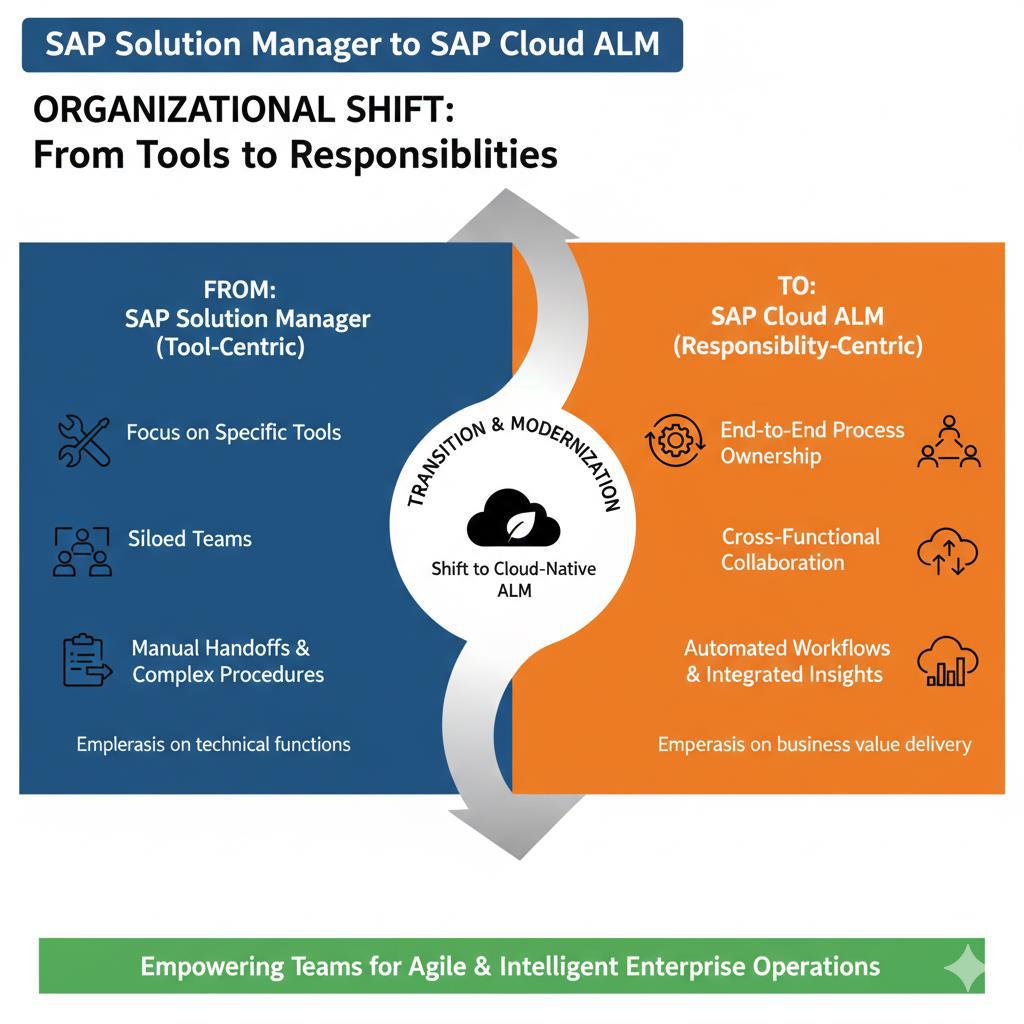
The move from Solution Manager to Cloud ALM is often described as a tool transition.
In reality, it is a responsibility transition.
With Solution Manager, organisations owned the platform.
They defined custom monitoring.
They extended workflows.
They controlled integrations.
With Cloud ALM, the model changes.
The platform is standardized.
The service boundaries are clearer.
The responsibilities shift between internal teams and SAP.
This affects:
- Basis teams
- Change managers
- Test managers
- Operations leads
- Governance stakeholders
Across transitions, we repeatedly see friction not in configuration — but in ownership.
Who defines monitoring scope?
Who approves workflow changes?
Who owns lifecycle transparency?
Who ensures alignment between implementation and operations?
If these questions are not clarified early, projects slow down.
Not technically — organisationally.
That is why the Controlled Replacement Model addresses roles before replacement begins.
Because capability replacement without responsibility alignment creates operational uncertainty.
In the final post, we will outline how successful organisations structure the entire transition — from first assessment to retirement of Solution Manager.
Why Configuration & Security Analysis Matters
Managing configurations and security settings in a complex SAP environment is challenging. Organizations face multiple risks:
Configuration Drift:
Security Vulnerabilities:
Compliance Gaps:
Limited Visibility:
Configuration & Security Analysis addresses these challenges by providing continuous insights into system settings, enabling proactive remediation and ensuring alignment with operational and security standards.