Transition is an Operating Model Change
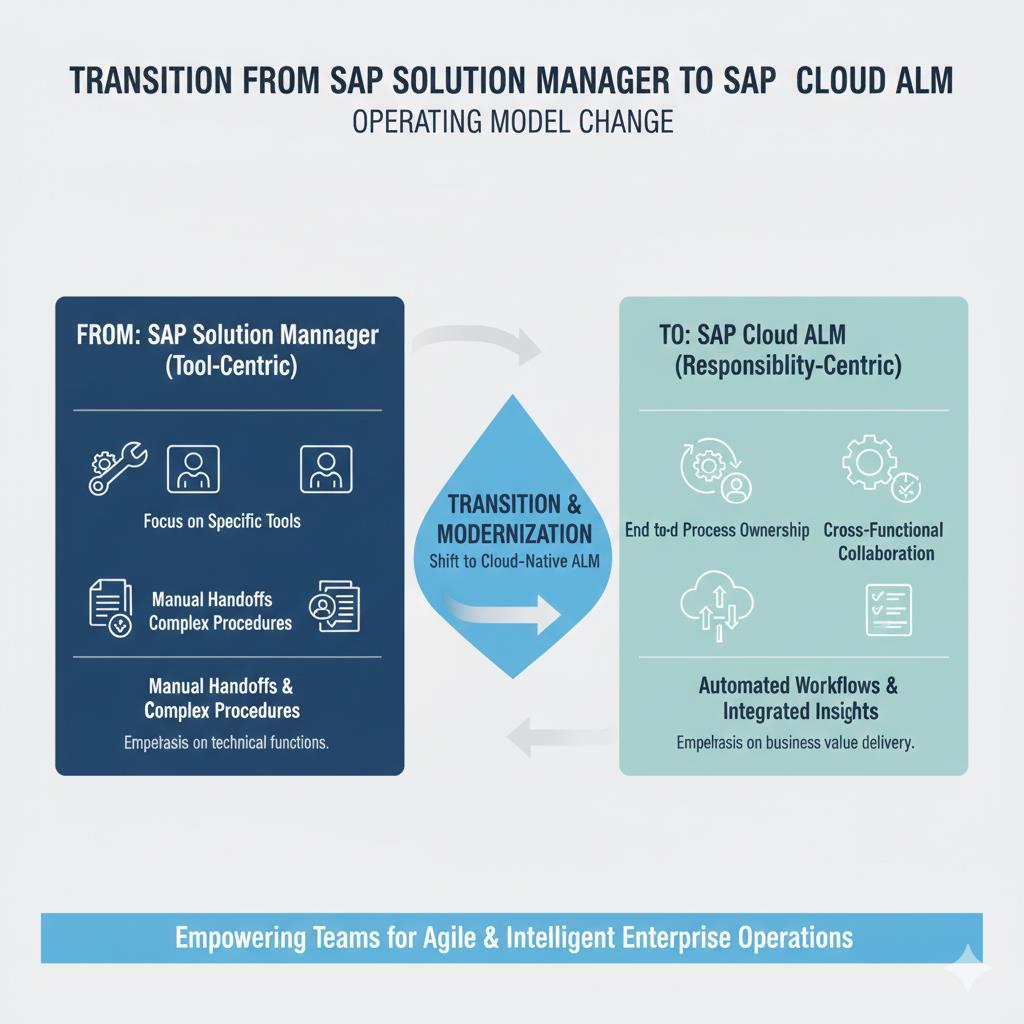
The transition away from SAP Solution Manager is often planned as a tool replacement.
In reality, it is an operating model change.
In many organisations, Solution Manager has evolved over years.
Monitoring, change control, documentation, integrations and internal processes have gradually adapted around it — often without being centrally designed.
When the move to SAP Cloud ALM is initiated, the planning therefore starts in the system landscape:
Which tenants to connect
Which scenarios to activate
Which data to migrate
But the technical setup is rarely where the real complexity sits.
What actually changes is responsibility.
With Solution Manager, the organisation owned the platform and adapted processes around it.
With Cloud ALM, the platform is predefined — and the organisation must adapt to the service model.
That shift affects governance, operations and decision making far more than the tooling itself.
Across multiple transitions we have seen that treating the move as a migration leads to uncertainty later in the project:
capabilities appear missing, processes behave differently and ownership becomes unclear.
For that reason we approach the transition as a controlled replacement rather than a migration — gradually understanding and replacing capabilities instead of moving a system.
Before planning the transition, the most important question is therefore not how to move, but what is actually running today.
And in most cases, that is less documented than expected.
Why Configuration & Security Analysis Matters
Managing configurations and security settings in a complex SAP environment is challenging. Organizations face multiple risks:
Configuration Drift:
Security Vulnerabilities:
Compliance Gaps:
Limited Visibility:
Configuration & Security Analysis addresses these challenges by providing continuous insights into system settings, enabling proactive remediation and ensuring alignment with operational and security standards.